How Much Heat a Sauna Needs in Winter
Fresh air keeps a sauna pleasant, and every cubic metre of it has to be heated from the outdoor temperature. This is the energy side of our sauna study. Where the air goes is covered in How Air Moves in a Sauna.
The short answer
In a 13.8 m³ sauna at −21 °C outside, about six air changes per hour keep CO2 near 820 ppm. With natural ventilation alone, at 2.5–3 air changes, CO2 rises to 1,250–1,400 ppm. Fresh air costs heat: going from 3 to 6 air changes raises energy use by about 60%, and the room needs about 8 kW to hold its temperature instead of about 5 kW.
The case
Aequa Cella, 3.0 × 2.0 × 2.3 m inside, with four people: two adults and two children. Inside, 80 °C. Outside, −21 °C: the design winter of Žabljak in Montenegro, one of the harshest in Europe. We took a hard climate on purpose; a milder one only makes the numbers smaller.
Air changes and CO2
Natural ventilation, 2.5 ACH: CO2 about 1,420 ppm.
Natural ventilation, 3.8 ACH (larger openings): about 1,100 ppm.
Mechanical, 4 ACH: 1,045 ppm; ventilation heat loss 3.3 kW.
Mechanical, 6 ACH: 837 ppm; 5.0 kW.
Mechanical, 8 ACH: 732 ppm; 6.6 kW.
Natural ventilation, 3.8 ACH (larger openings): about 1,100 ppm.
Mechanical, 4 ACH: 1,045 ppm; ventilation heat loss 3.3 kW.
Mechanical, 6 ACH: 837 ppm; 5.0 kW.
Mechanical, 8 ACH: 732 ppm; 6.6 kW.
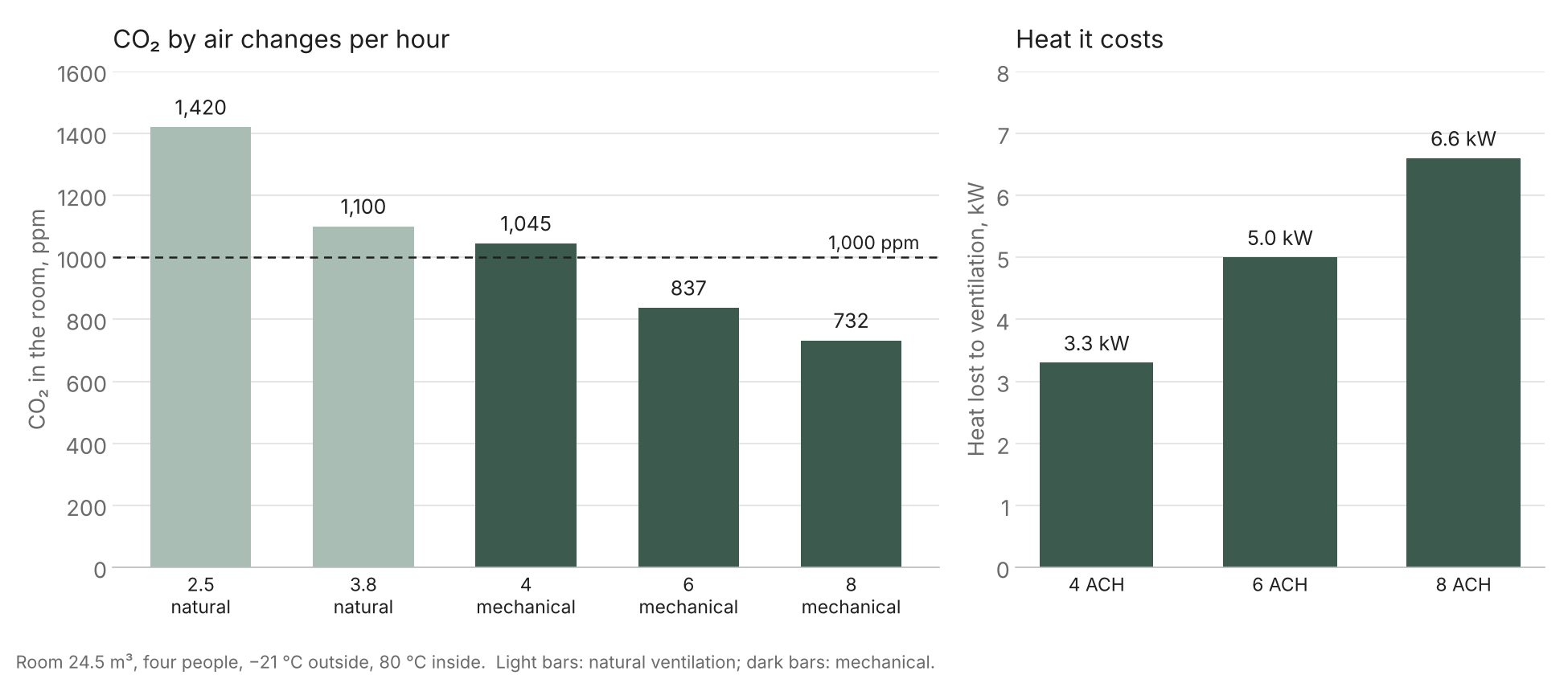
ACH means air changes per hour. To keep CO2 below 1,000 ppm, the room needs at least 5–6 ACH. Beyond that, the air gets only slightly better while the heat loss keeps climbing.
Heat through the walls
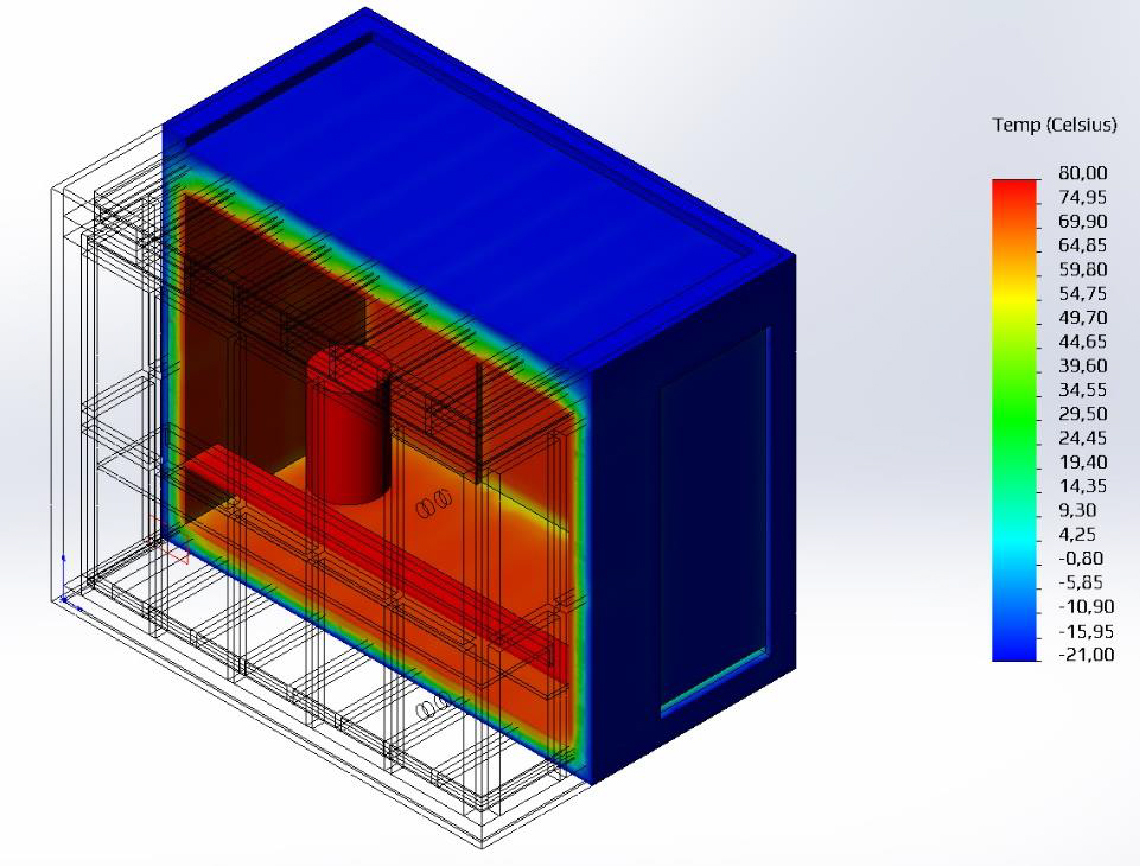
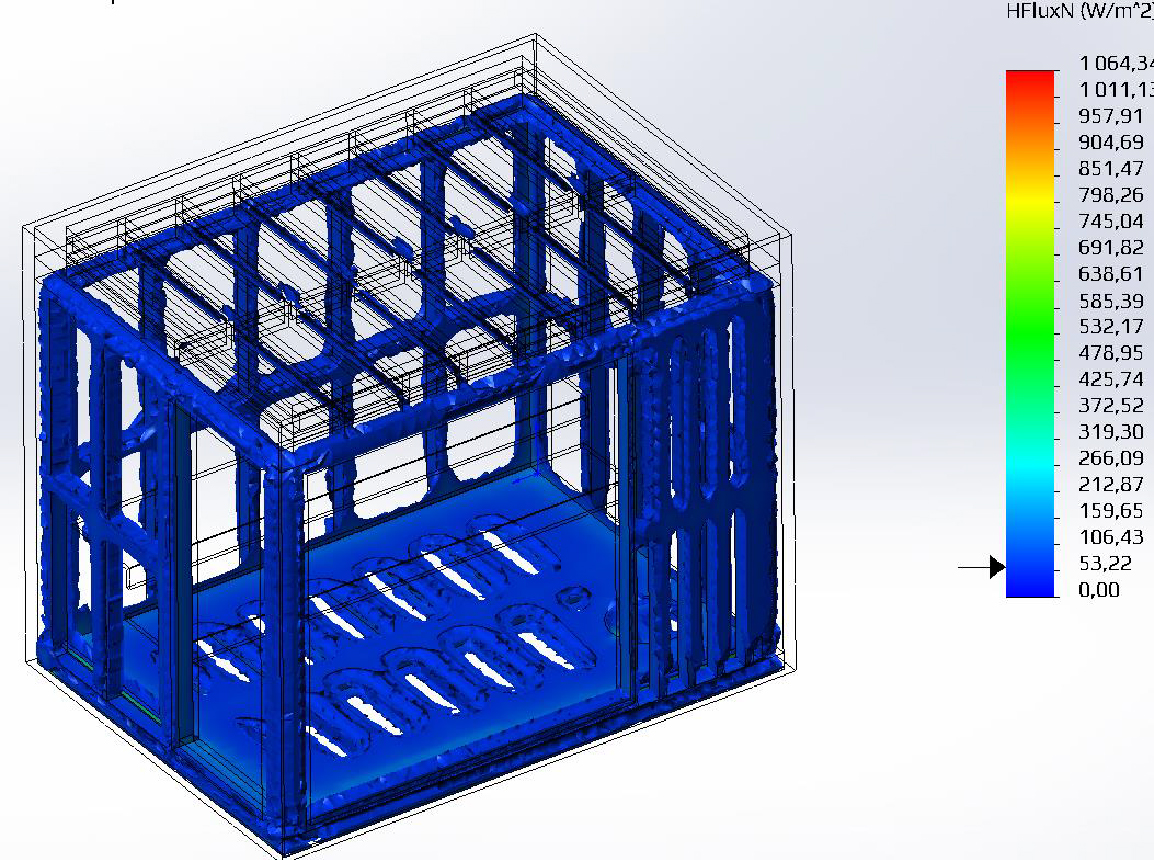
Heat leaving through the walls, floor, roof, door and window comes to about 1.9 kW at −21 °C; the walls account for more than half. We modelled the envelope in 3D, so joints and thermal bridges count, not only the U-values on paper. Glass costs heat: even a small window adds 0.1–0.2 kW.
How big a heater
Add the ventilation loss and a 25% margin, and the room needs about 8 kW of heat at 6 ACH, against about 5 kW with natural ventilation.
8 kW is what the room draws to hold its temperature, not the rating on the heater. The heater runs in its medium-to-nominal range and keeps reserve to warm the room up quickly. That is why the CFD run in part one, with the heater at full output, shows 98 °C on the benches.
What it costs to run
At 2 hours a day and €0.10 per kWh, 8 kW costs about €48 a month, and 5 kW about €30. The climate moves these numbers with the temperature difference: at −10 °C outside the same sauna uses about 11% less energy, at −30 °C about 9% more.
What to take from it
1. For a sauna used by groups, plan for 5–6 air changes per hour.
2. Run two modes: about 3 ACH while the sauna waits for guests, about 6 ACH during sessions.
3. Below −20 °C outside, pre-heat the incoming air to avoid condensation.
4. Size the heater for the climate and the ventilation, not just the room volume.
5. Count the glass: every window adds to the load.
2. Run two modes: about 3 ACH while the sauna waits for guests, about 6 ACH during sessions.
3. Below −20 °C outside, pre-heat the incoming air to avoid condensation.
4. Size the heater for the climate and the ventilation, not just the room volume.
5. Count the glass: every window adds to the load.
How this shaped Æqua
The commercial grade of Æqua controls its ventilation with a CO2 sensor, so the air rate rises when people are inside and drops when the room is empty. Heater power is chosen per project, for the room, the ventilation and the local climate. For the standard on public saunas, see EN 18164:2026 Explained.
Results apply to the modelled room, heater and design conditions (November 2025). A different room, climate or occupancy gives different numbers.
Engineering study by Leonid Heikkonen, energy modelling engineer.
By Gennadii Bakunin, Founder & CEO, Brette Haus
By Gennadii Bakunin, Founder & CEO, Brette Haus
11.2026
See also


