How Air Moves in a Sauna: What Our CFD Study Showed
Most advice on sauna ventilation is folklore: a vent here, a gap under the door there. For Æqua we modelled the air instead. This part covers where the air goes. The second part, How Much Heat a Sauna Needs in Winter, covers air changes, heater power and running cost.
The short answer
Bring fresh air in low, behind the heater, and take it out in two places on the far side: one high, one low. Done this way, the benches get even heat and no draught, and with about six air changes per hour CO2 stays near 820 ppm with a small group inside.
What we modelled
The room: Aequa Cella 3.0 × 2.0 × 2.3 m inside, 13.8 m³, with two benches along the long wall, a large window and an electric heater on a floor pedestal.
The climate: the winter of Žabljak in Montenegro, one of the harshest in Europe, with a design outdoor temperature of −21 °C. Inside, 80 °C. That is a 101 K difference.
The tools: an energy-balance model in Python using standard climate files; a 3D heat-transfer model of the walls, floor, roof, door and window in SolidWorks to ISO 10211, including joints and thermal bridges; and a CFD model of the air in OpenFOAM, post-processed in ParaView.
Where the air comes in and goes out
Fresh air enters through two inlets behind the heater, about 0.5 m above the floor, so it is warmed at once and rises with the hot plume. Air leaves on the far side through two exhausts, at about 0.55 m and 2 m. The high one takes 70% of the flow and removes the hottest, most humid air and the CO2. The low one takes the remaining 30% and evens out the temperature between the top and bottom of the room. All ducts are 100 mm, with fans of 105 m³/h.
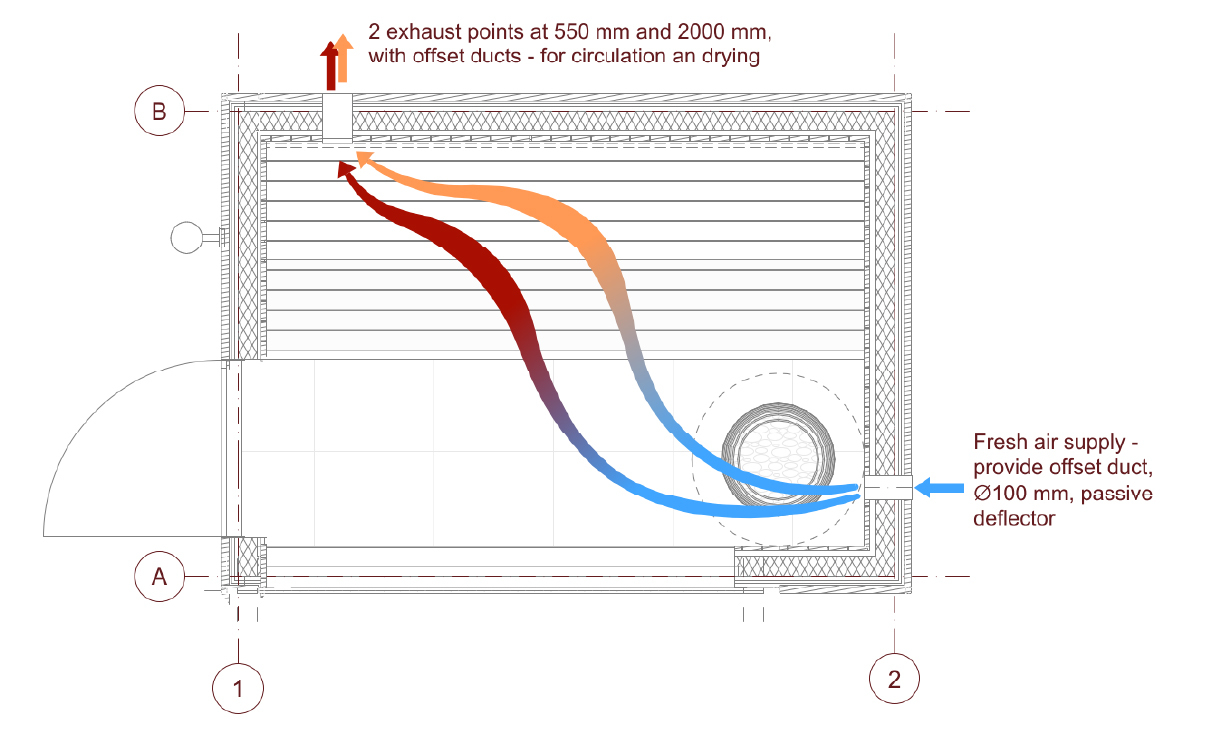
Without this mixing, the top of a 2.3 m high sauna is 20–25 °C hotter than the bottom.
What the model showed
A stable plume. Hot air rises steadily from the heater to the ceiling and rolls back down along the walls. The only fast air in the room is the inlet jet by the heater.
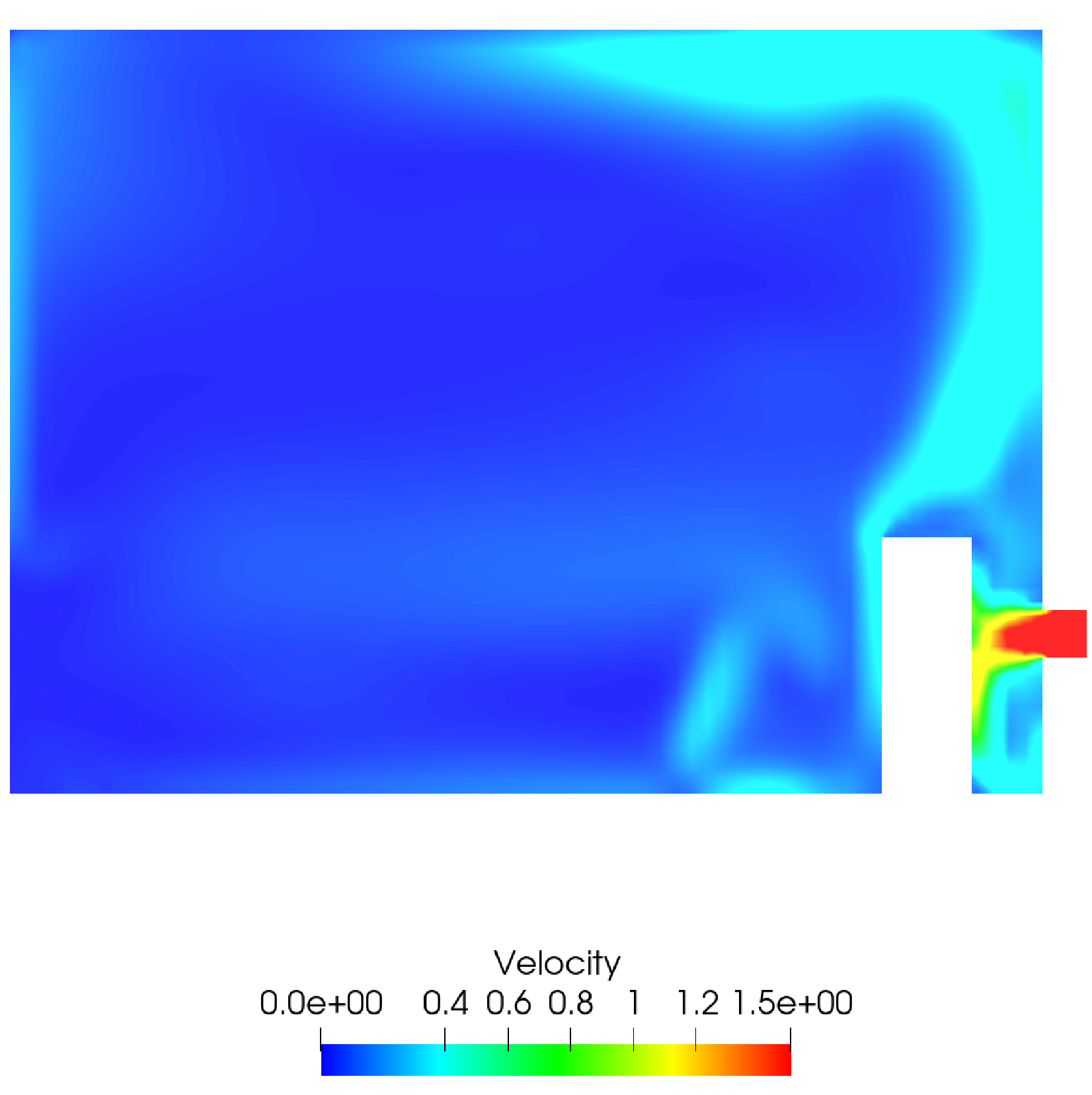
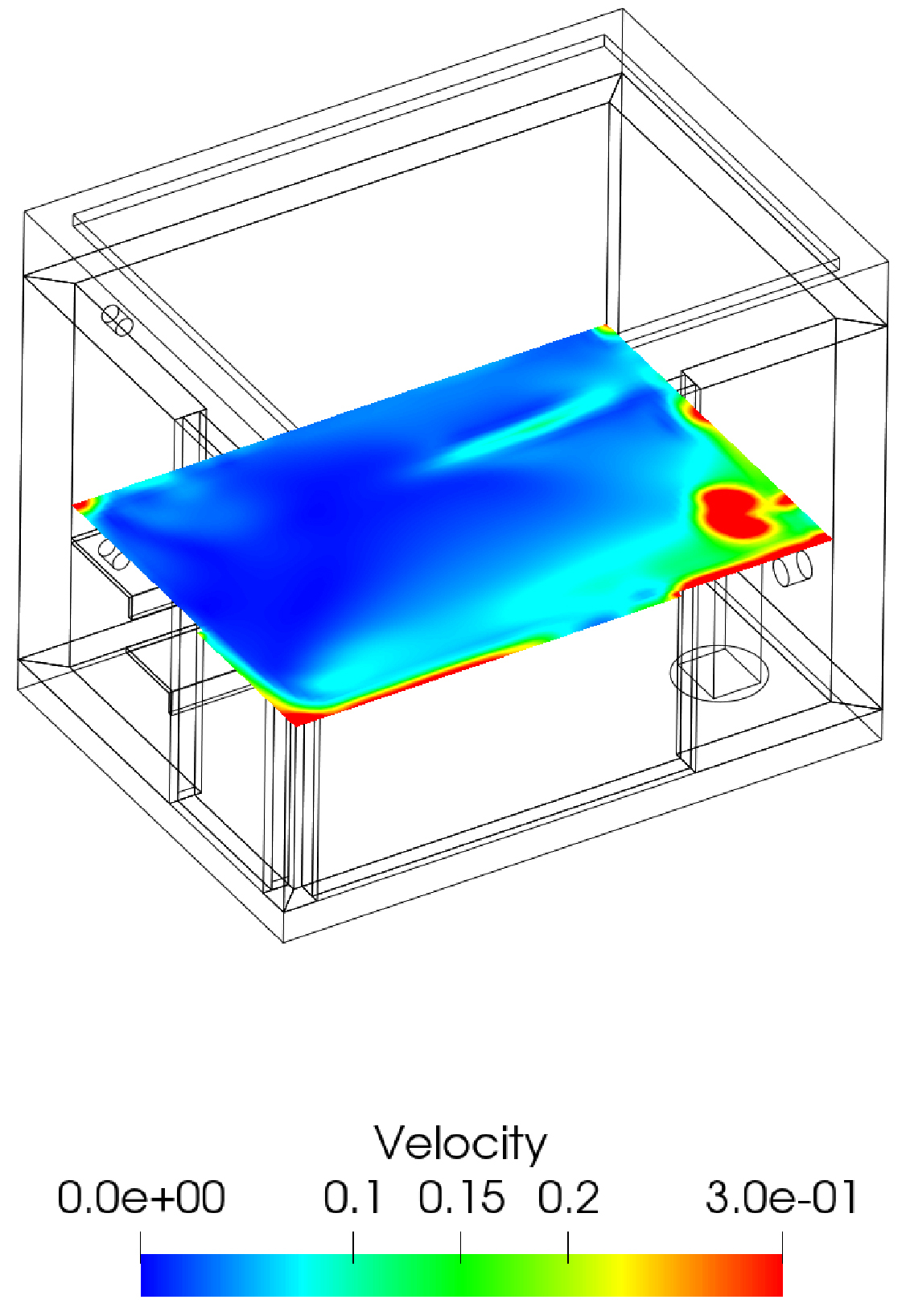
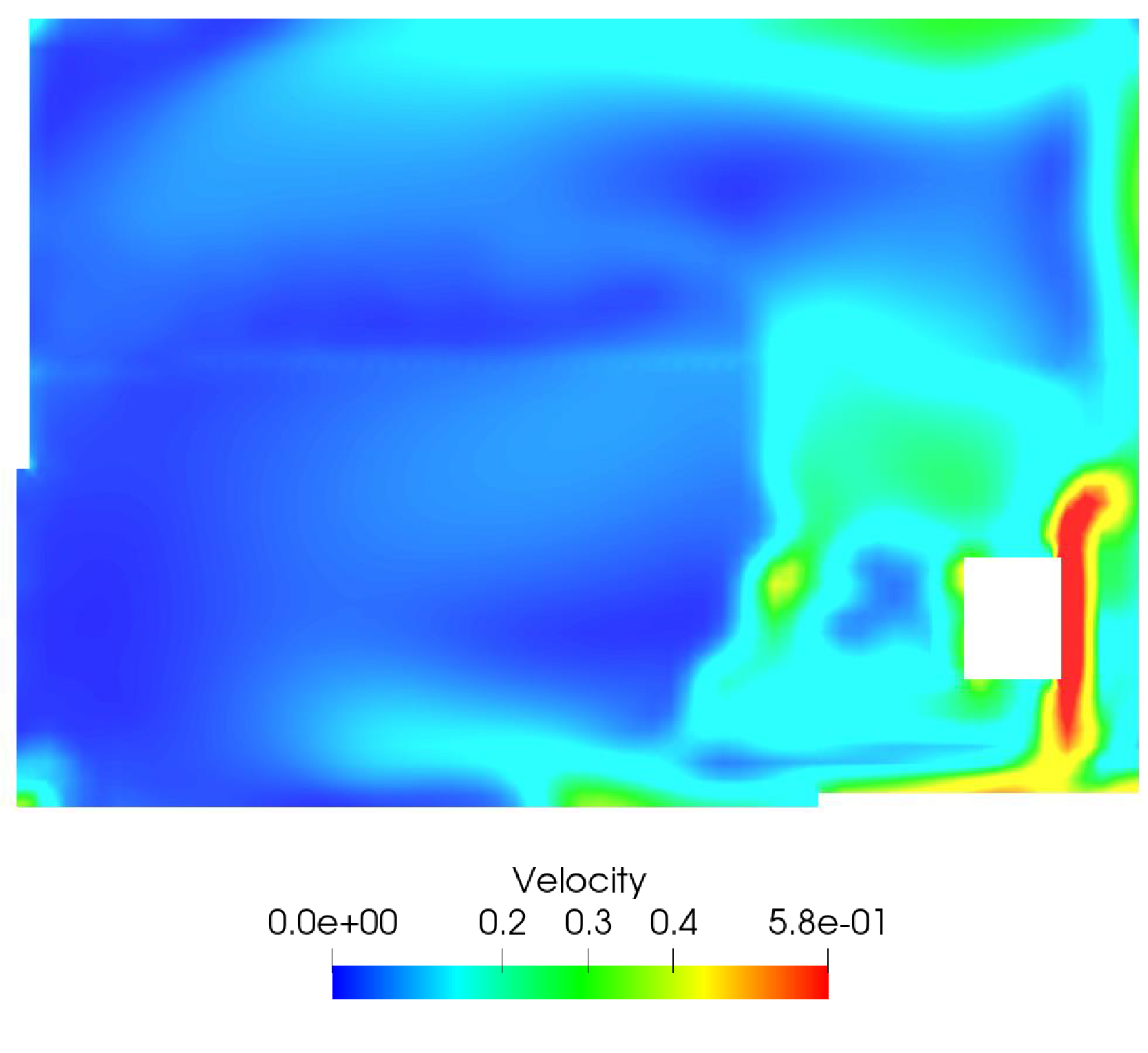
No draught on the benches. Air speed in the bench zone stays at or below 0.2 m/s. The fastest air, 0.58 m/s, is 300 mm above the floor by the inlets, where nobody sits.
Even heat. The CFD run is a stress test, with the heater at full output. Even then the bench zone is even, at 98 °C on average, and hotter only right above the heater. In daily use the heater works at a medium setting; the second part explains the numbers.
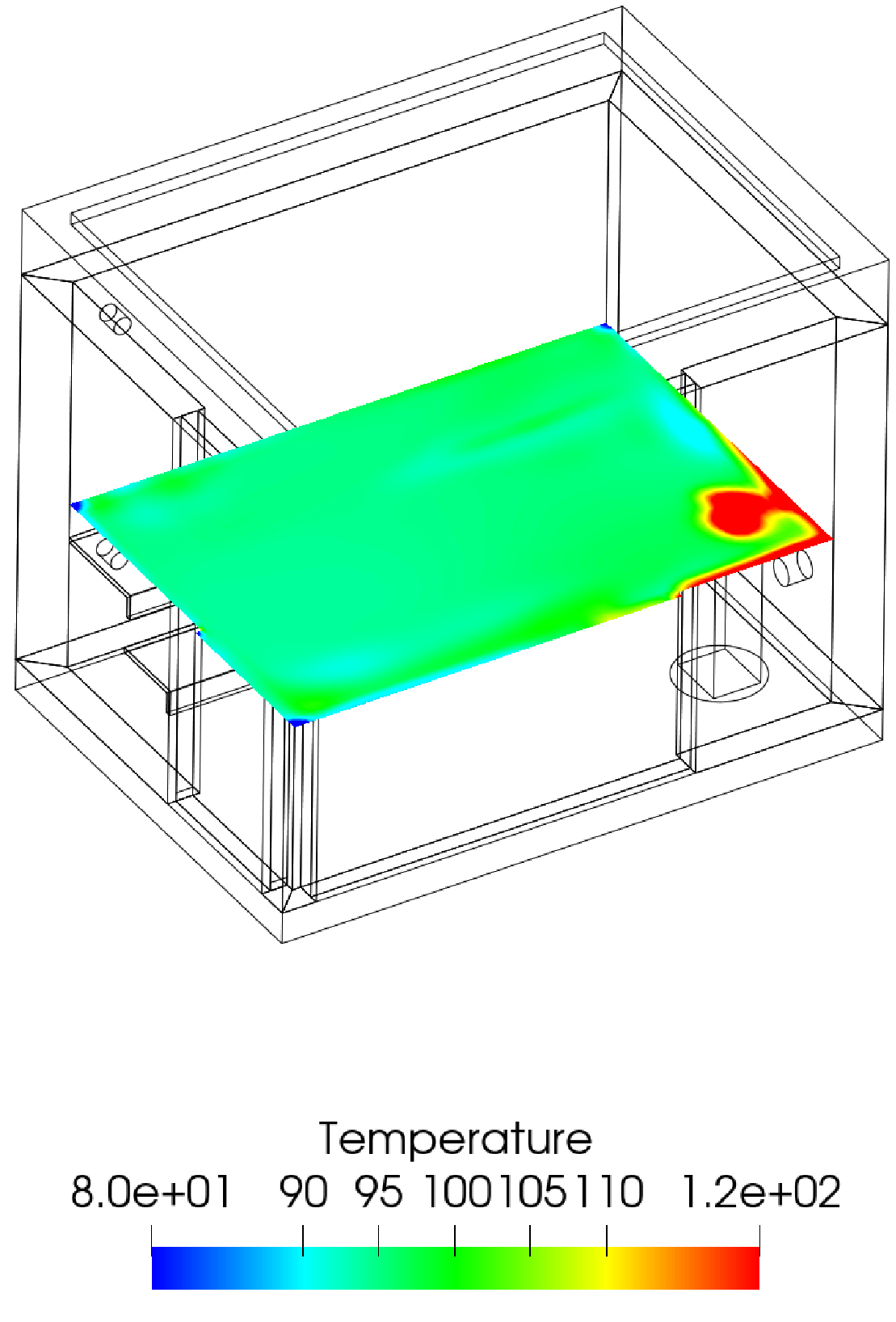
The floor takes the most radiant heat. About 3.1 kW of the heater's radiation lands on the floor, more than on any wall, the window or the ceiling.
Clean air. At 6.3 air changes per hour, CO2 settles at 819 ppm. Outdoor air is about 420 ppm.
Clean air. At 6.3 air changes per hour, CO2 settles at 819 ppm. Outdoor air is about 420 ppm.
What to take from it
1. Bring fresh air in low, behind or under the heater, so it is warm before it reaches anyone.
2. Take it out on the opposite side: high for most of the flow, plus a smaller low exhaust to even out the temperature.
3. Keep the benches out of the inlet jet. Fast air belongs low, by the heater.
4. If groups use the sauna, plan for 5–6 air changes per hour. What that costs in heat is in part two.
How this shaped Æqua
The commercial grade of Æqua uses mechanical ventilation controlled by a CO2 sensor, designed on this study: 6.3 air changes per hour, CO2 below 820 ppm and air on the benches below 0.2 m/s. The residential grade uses natural ventilation, designed with the same simulations. For the standard on public saunas, see EN 18164:2026 Explained.
Results apply to the modelled room, heater and design conditions (November 2025). A different room, climate or occupancy gives different numbers.
Engineering study by Leonid Heikkonen, energy modelling engineer.
By Gennadii Bakunin, Founder & CEO, Brette Haus
By Gennadii Bakunin, Founder & CEO, Brette Haus
11.2026
See also


